
Easley SC Public Records
Easley public records are held by the City of Easley, the Easley Police Department, the Easley Municipal Court, and Pickens County offices. Residents can request police reports, court records, and city documents through the Easley Police Department's Records Division or the City Clerk's office. Easley follows South Carolina's Freedom of Information Act, giving the public the right to access and copy government records. This guide covers the main sources for searching and obtaining Easley public records, from incident reports and municipal court cases to county court filings and online databases.
Easley Quick Facts
Public Records in Easley
Easley is the largest city in Pickens County and serves as a hub for public services in the northwestern Upstate area of South Carolina. City records are maintained by the City Clerk's office at 220 NW Main Street, Easley, SC 29640. The Clerk holds council minutes and agendas, ordinances, resolutions, city contracts, special permits, and budget documents. Boards and commissions records and notary services are also available through the City Clerk.
The City of Easley website provides access to city services, department contacts, and records request information. Records such as council meeting minutes and financial documents are often posted online. For records that are not available online, a written FOIA request must be submitted. Some records can be reviewed in person at City Hall without a formal request.
For court and property records beyond the city level, Pickens County offices are the appropriate destination. The Pickens County Clerk of Court maintains General Sessions, Common Pleas, and Family Court records. The Register of Deeds holds property deeds, mortgages, and plats for all of Pickens County including Easley.
Easley Police Department Records
The Easley Police Department Records Division is located at 220 NW Main Street, Easley, SC 29640. It is open Monday through Friday from 8:30 a.m. to 5:00 p.m. The division closes daily for lunch from 12:00 p.m. to 1:30 p.m. The records phone number is (864) 855-7923 and the email is records@easleypd.org.
Records available from the EPD include copies of collision reports, copies of incident reports, and responses to FOIA requests. Motion of Discovery requests for attorneys are also handled by the Records Division. To request records, email records@easleypd.org with a copy of your photo ID, or visit the Records window in person. All requests are processed in the order received. To file a police report, call the non-emergency line at 864-859-4025.
The Easley Police Department's FOIA page explains the city's policy for releasing public records and lists the accepted methods for submitting requests.
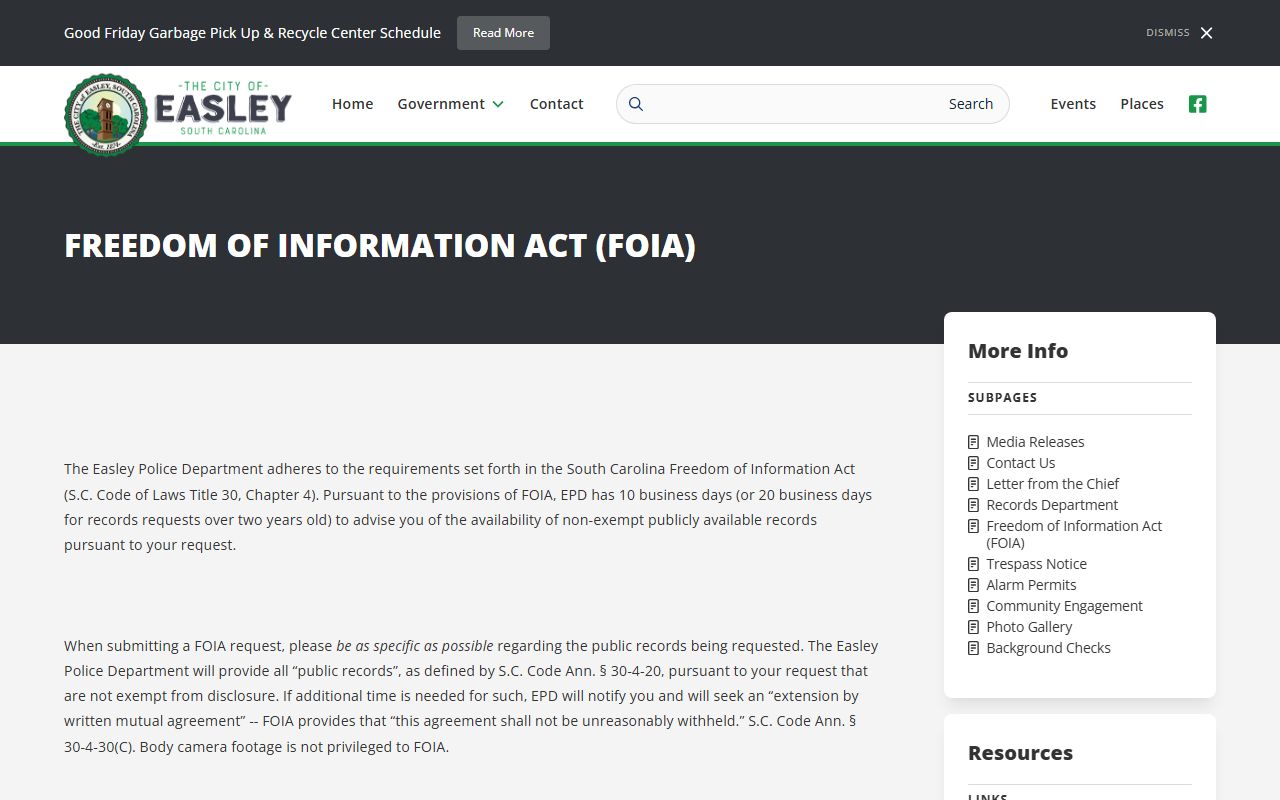
Visit cityofeasley.com for the Easley Police Department's full FOIA policy and request procedures.
Body camera footage is not exempt from FOIA in Easley. Such requests are treated as standard FOIA requests and are subject to the same response timelines. Fees cannot exceed the actual cost of search, retrieval, and redaction. The full fee must be paid before records are produced or delivered. If an extension is needed, it can be arranged by written mutual agreement between the requester and the department.
Note: Active law enforcement investigations are exempt from FOIA disclosure. Records tied to closed investigations are generally releasable upon written request.
How to Request Easley Public Records
Public records requests to the Easley Police Department can be submitted by email at records@easleypd.org or by mail to the Easley Police Department, Records Division, 220 NW Main St, Easley, SC 29640. Requests to the City Clerk for non-police records can be submitted at city hall in person, by mail, or by email. No reason is required to request public records in South Carolina.
State law at Title 30, Chapter 4 requires a 10-business-day response for records less than 24 months old. For records older than 24 months, the response window extends to 20 business days. Production of records must occur within 30 calendar days after the determination to release. Be as specific as possible when writing your request. Include incident numbers, names, dates, or document types to help speed the search.
Fees are set by state statute at S.C. Code of Laws Section 30-4-30(B). Fees may not exceed the actual cost of search, retrieval, and redaction. Paper copies are typically $0.25 per page. Electronic transmissions carry no copy fee. A deposit of up to 25% of the estimated cost may be required in advance. Full payment must be received before production begins.
Easley Municipal Court Records
Easley has its own Municipal Court, which is a summary court within the South Carolina judicial system. The court has jurisdiction over misdemeanor criminal matters, traffic violations, and city ordinance violations within Easley city limits. The penalty limits are up to $500 in fines or up to 30 days in jail. An exception applies to driving under suspension cases, where the court has exclusive jurisdiction and can impose fines up to $2,100 and up to 180 days in jail.
Common violations handled by the Easley Municipal Court include drug possession, criminal domestic violence, assault and battery, disorderly conduct, shoplifting, larceny, DUI, and speeding. The court was formerly known as City Recorder's Court and then Mayor's Court. Judges in the court issue arrest warrants, search warrants, and bench warrants. Bond hearings must be held within 24 hours of arrest.
The Easley Municipal Court handles traffic and ordinance cases as well as certain criminal misdemeanor matters.
Learn more about the Easley Municipal Court at cityofeasley.com/subpages/about-municipal-court.
Court records from the Easley Municipal Court are public records. The Clerk of Court manages the docket, collects fines, and responds to public inquiries. For traffic matters, a No Contest plea is treated as a conviction for driving record purposes. Four-point violations can be removed by completing a Defensive Driving Course through Greenville Technical College, Tri-County Technical College, or online. The course may be taken once every three years. Victim services are available by calling 864-859-4025 or 864-855-7945.
For felony and other major court matters, the Pickens County Clerk of Court handles records. Search Pickens County cases for free at the SC Judicial Branch Public Index.
Searching Easley Records Online
Several online tools are available for searching Easley public records without a formal FOIA request. The SC Public Index provides free court record searches for all 46 South Carolina counties including Pickens. You can search by party name or case number. Results include case status, hearing dates, and attorney information. Home addresses have been removed from results since January 2026.
For name-based criminal history checks, the SLED CATCH system costs $25 per search for individuals and $8 for charities. A name and date of birth are required. Mail requests can be sent to SLED Records Dept, PO Box 21398, Columbia, SC 29221-1398. The CATCH phone number is 803-896-1443. The SLED Sex Offender Registry is free and searchable online for the Easley area.
Business records for Easley companies are available through the Secretary of State's business filings portal. Voter registration records are at scvotes.gov. The SC Department of Archives and History holds historical state records useful for genealogical and property research in the Pickens County area.
Pickens County Public Records
Easley is in Pickens County. Court and property records for Easley are filed at the Pickens County courthouse. Visit the county page for complete records access.
Nearby South Carolina Cities
Easley is in the northwestern Upstate region of South Carolina near Greenville and Pickens County. These nearby cities share overlapping court systems and state records infrastructure.